
Why did Amer grow into a royal stronghold?
Amer, often written Amber, served as the Kachwaha rulers’ seat before Jaipur’s planned city was founded in 1727. The fort-palace expanded over generations, particularly from the late sixteenth century, when defensive walls, residential courts and ceremonial spaces took shape around the hill. Maota Lake below supported the settlement and framed the approach. Rather than imagining one architect completing a single building, read the site as a layered complex shaped by rulers, artisans and changing court life. Rajput planning sits alongside decorative influences that developed through political ties across north India. The ridge offered protection; inner courts separated public audiences from private rooms. A cab makes the journey easier, but the visit itself is on foot and includes slopes, thresholds and uneven paving. The Amer–Nahargarh–Jaigarh circuit can connect the fort with the other ridge landmarks.
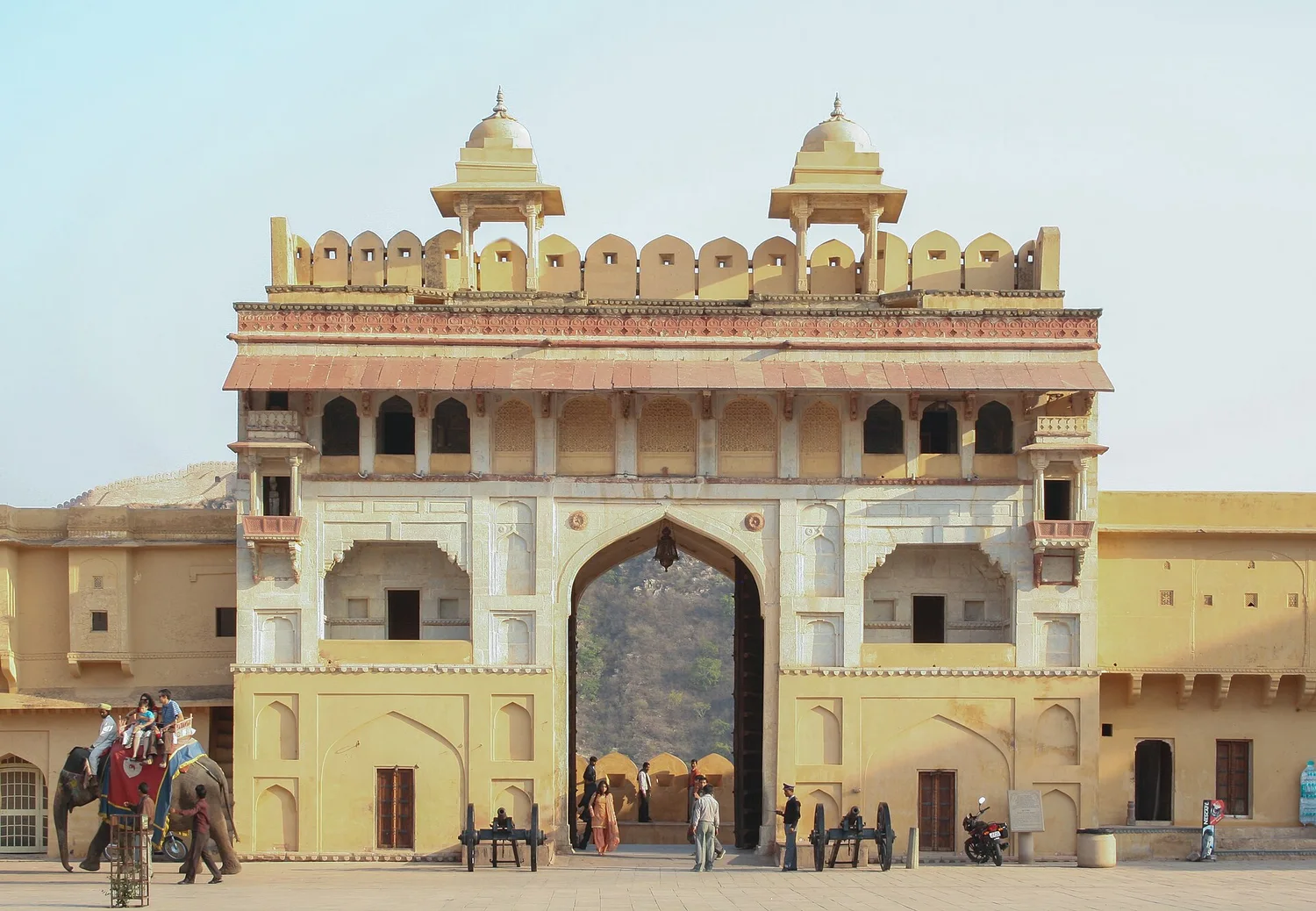
What does Ganesh Pol reveal about palace movement?
Ganesh Pol is one of the most recognizable gateways in the palace, but its value is more than decorative. It marks a transition between courtyards and helps visitors understand how access was managed within the royal complex. Look at the painted and carved details from the permitted route; surfaces are vulnerable to touching and flash photography. The gateway’s elevated position and ornamented face create a ceremonial threshold, a visual announcement that the next section had a different role. Nearby passages connect to courtyards used for audiences and household activity. A guide can explain how gates controlled movement without treating every doorway as an isolated photo stop. Allow a few minutes to observe the alignment and the view back toward the lower court. If crowds are dense, keep your group together rather than stopping across a narrow passage. Entry rules may change during maintenance, so follow the current staff directions.
How did Diwan-e-Aam serve the court?
Diwan-e-Aam, the Hall of Public Audience, was associated with formal meetings between the ruler and visitors or petitioners. Its columns, open sides and raised setting help explain the public nature of the space. The structure is a reminder that a palace functioned as an administrative centre as well as a residence. Notice how the hall’s edges frame the courtyard and how people could be arranged around the central ceremonial area. Avoid inventing a precise story for every carved feature; a local guide or museum label is the better source for specific interpretation. Visitors often hurry toward mirrored rooms, but pausing here places those private interiors in context. Photography may be restricted in certain areas, and staff can adjust the route to protect conservation work. For a first visit, plan an unhurried circuit that leaves room for interpretation rather than counting rooms.
What makes Sheesh Mahal different from an ordinary room?
The Hall of Mirrors, commonly called Sheesh Mahal, uses small reflective pieces and painted ornament to create a luminous interior. The effect depends on how light reaches the surfaces, not on a modern electric display. Visitors should not touch the mirrors, press against the walls or use flash unless the rules explicitly allow it. Conservation and crowd management may limit where you can stand, so follow floor markings and any rope barriers. The room is smaller than many visitors expect from photographs; its intimacy is part of the experience. Look at the repeated floral patterns and how the reflective fragments respond to daylight. A guide can point out details that are easy to miss while a queue moves through. The palace’s rooms are not all open at all times, so treat access to a particular chamber as subject to the day’s operation.
Where does Maota Lake fit into the fort story?
Maota Lake lies beneath the palace approach and gives the hilltop complex a strong visual foreground. Historically, water management mattered in this dry region, and the lake helped sustain the settlement as well as shape its ceremonial view. From the approach, notice how the fort’s walls, gardens and water edge relate to one another. Do not assume that a boat ride or lakeside activity is available; current access is governed locally. The lake is also an orientation point: passengers can see why the fort was established above the valley rather than on the flat plain. Stop only in the approved vehicle area and avoid blocking the road while taking a photograph. Combine the visit with nearby Panna Meena ka Kund if the stepwell is open, then continue toward Jaigarh only if the group has sufficient energy.
How should visitors choose a ticket and visit length?
Ticket categories, entry hours and camera rules can change. Treat any quoted Indian or foreign visitor charge as approximate and confirm it at the official counter before entering. A basic walk-through may take around two hours; visitors who study the courtyards, displays and views should reserve longer. Some attractions have separate access arrangements, so ask which rooms and experiences the ticket includes. A guide is useful when you want historical context, while independent visitors should read the on-site information instead of rushing from one photo point to another. Keep identification and payment ready, but carry only a small day bag through security. The car fare does not ordinarily include monument admission. If the fort is a central priority, schedule it first rather than placing it at the end of a full-day circuit.
Should you walk uphill or use a vehicle transfer?
The final approach involves a climb from the lower area, and options depend on current rules, health and access. Walking lets you pause at your own pace but can be strenuous in heat or for someone with knee problems. Local jeep services may operate under separate management; verify availability, price and safety conditions at the site instead of assuming a ride is guaranteed. Elephant rides have raised welfare concerns, and visitors who want to avoid animal use can choose the pedestrian route or a permitted vehicle transfer. Never pressure an animal handler or approach elephants without instruction. The taxi normally drops passengers at the designated area and may need to park elsewhere, so agree on a return point. For older guests, ask staff about the most accessible courtyard route.
When can the evening light show be seen?
The fort has offered light-and-sound presentations in some seasons, but show language, timing, ticketing and availability can change. Confirm the current program directly with the venue or official tourism information on the day. Do not base a return train or dinner reservation on an old schedule copied from a travel forum. An evening presentation can add context about Amer’s rulers and architecture, yet it also extends the visit and delays the drive back. If the group is attending, book enough waiting time with the taxi and clarify the night-return charge beforehand. Walking areas may be dim after the show; use the marked paths and stay together. In rainy or windy conditions, an event may be altered or cancelled. A daylight visit remains worthwhile even if no evening program runs.
Which nearby stops make a sensible half-day?
Panna Meena ka Kund is a short local drive away, while Jaigarh Fort sits along the ridge and needs a separate vehicle climb and walking allowance. Jal Mahal is on the return corridor toward the city, not a walkable extension from Amer. Choose one addition based on the group’s interest: water architecture, another fort or a lakeside pause. The Amer Fort details and Jaigarh visitor notes help compare their walking demands. A sedan suits a small party; a roomier SUV can help families carrying water, hats and a change of clothes. Ask the operator whether the quoted trip is a fixed-duration package or an hourly rental. Adding stops can affect both kilometres and waiting time.
Who should plan extra accessibility time?
Guests using a cane, travelling with toddlers or managing a chronic condition should estimate walking in advance. Stone ramps, stairs, uneven surfaces and crowded gateways can make the fort harder than its map pin suggests. Ask staff about accessible sections and available assistance at the entrance; do not assume every interior route is step-free. Wear shoes with grip and carry water, especially from April through June. Children should stay beside an adult around ramparts and stair edges. If one person needs a quiet break, agree on a shaded meeting point instead of separating the group. A private Jaipur sightseeing car can keep the pickup plan flexible after the visit. The most rewarding schedule is one that leaves visitors enough energy to notice the architecture, not merely reach every gate.